
Museums and events are no longer limited to displaying objects, photographs, and printed information. Visitors increasingly expect experiences that allow them to see, explore, and interact with stories in more engaging ways. ViitorX is part of a wider industry shift toward immersive experience design, where 3D environments, holographic displays, spatial audio, and interactive technology are being used to make information more memorable. In 2026, 3D and Holographic Experiences are becoming especially useful for museums, exhibitions, cultural institutions, expos, and live events because they can turn complex ideas into visual experiences that audiences can understand more naturally.
What Are 3D and Holographic Experiences?
3D and Holographic Experiences combine digital content, spatial design, visual effects, and interactive technologies to present information in a more immersive format. Instead of simply looking at a flat image or reading a long description, visitors can experience a digital object, reconstruction, person, place, or story from different perspectives.
3D technology can recreate historical locations, architectural structures, artefacts, products, or environments. Holographic-style displays can then present digital subjects with a strong sense of depth and presence.
The goal is not technology for technology’s sake. A successful experience should make a story easier to understand and encourage visitors to spend more time exploring it.
How 3D and Holographic Experiences Are Changing Museums
Museums have an important challenge: they need to preserve authentic objects while also making their stories understandable to modern audiences. Digital experiences can help bridge that gap.
1. Bringing Historical Objects to Life
A museum may have an important artefact that visitors cannot touch or examine closely. A detailed 3D representation can allow people to explore its shape, details, and construction without putting the original object at risk.
For example, a digital model can be enlarged on a screen so visitors can see small details that would normally be difficult to notice. Information can appear as visitors explore different parts of the object.
2. Reconstructing Lost Places
Some historical buildings and archaeological locations no longer exist in their original form. 3D reconstruction can provide visitors with an impression of how these locations may have looked.
This can be particularly useful for heritage exhibitions. Instead of seeing only drawings or photographs, visitors can move through a reconstructed environment and understand the relationship between buildings, people, and surrounding spaces.
Research published in 2026 continues to highlight VR and AR as useful tools for heritage reconstruction and visitor engagement.
3. Making Museum Learning More Interactive
Traditional museum learning often depends on reading labels and listening to guides. Interactive digital experiences give visitors another way to learn.
A visitor could rotate a 3D artefact, explore a historical map, follow an animated timeline, or interact with a digital reconstruction. This encourages active participation instead of passive observation.
Recent 2026 research also shows growing interest in multisensory museum experiences, including touch-based interaction alongside visual and audio elements.
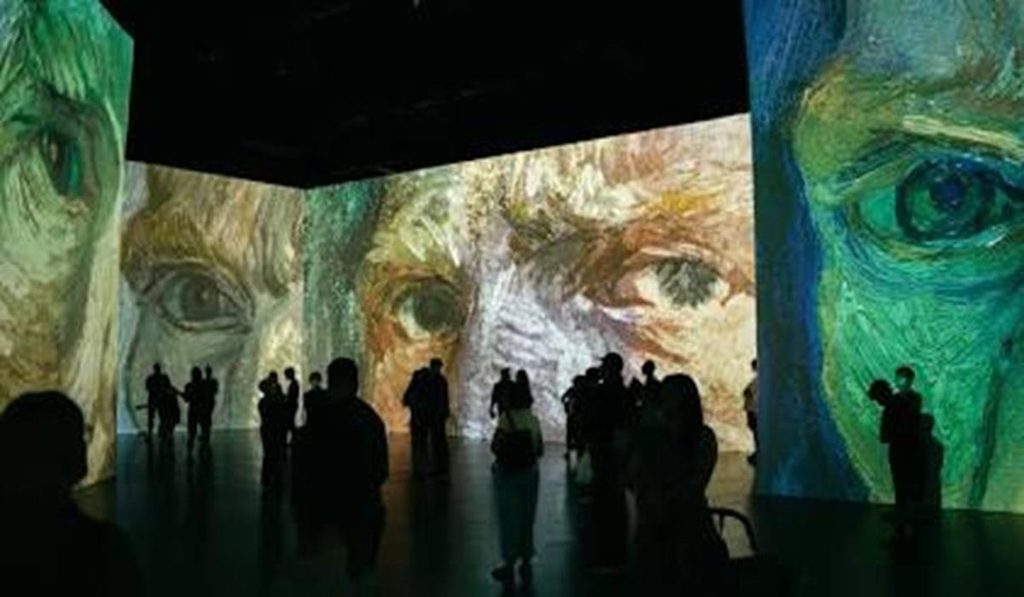
How 3D and Holographic Experiences Are Transforming Events
The same technologies are also changing how exhibitions, conferences, expos, and public events communicate with audiences.
Creating Attention-Grabbing Event Installations
At a busy event, many brands and organizations compete for visitor attention. A conventional display can easily become part of the background.
A large 3D visual, interactive digital installation, or holographic display can create a stronger visual point of interest. Visitors may stop to investigate what they are seeing, giving organisers an opportunity to communicate information through a short and memorable experience.
Explaining Complex Products and Ideas
Some products and concepts are difficult to explain with brochures or static presentations. 3D visualisation can simplify them.
For example, an organisation could show the internal structure of a machine, the development of a city, an architectural project, or the working process of a complex system through an interactive digital model.
This approach can reduce the amount of technical explanation needed because visitors can see the concept rather than only hear about it.
Supporting Large-Scale Storytelling
Holographic and 3D technologies can also support storytelling at public events. Historical figures, scientific concepts, cultural subjects, or future scenarios can be presented through carefully designed digital narratives.
The strongest installations normally combine visual content with lighting, sound, motion, and spatial design rather than relying on a single screen.
Why Visitor Interaction Matters in 2026
Immersion does not automatically mean engagement. The experience still needs a clear purpose.
A 2026 study on virtual museum experiences found that guidance and mobility can influence a visitor’s sense of presence, while greater presence can improve perceived entertainment and informativeness.
This means designers need to think about what visitors should do, not only what visitors should see.
- Touchscreen exploration of 3D objects.
- Gesture-based navigation.
- AR overlays on physical exhibits.
- Interactive projections.
- VR environments.
- Spatial audio.
- Motion-responsive digital content.
- Holographic-style visual displays.
The experience should remain simple enough for visitors to understand quickly. If people spend too much time learning how to operate the technology, the story can get lost.
Accessibility and Practical Challenges
Although immersive technology offers many possibilities, museums and event organisers also need to consider practical limitations.
Accessibility should be part of the design from the beginning. Some visitors may not be comfortable using headsets or complex interfaces. Others may need captions, audio descriptions, alternative controls, or a non-headset version of the experience.
A 2026 heritage study found that immersive projects can improve engagement and learning, but also identified concerns around accessibility, technical reliability, authenticity, and operational planning.
There are also other considerations:
- Hardware needs regular maintenance.
- Digital content may need updates.
- Visitor flow must be carefully planned.
- Equipment should withstand repeated public use.
- Staff may require training.
- Experiences should have alternatives for visitors who cannot use certain technologies.
- Museums need to balance digital interpretation with the authenticity of physical collections.
These factors are important because an impressive concept still needs to work reliably on a real museum floor or event venue.
The Future of 3D and Holographic Experiences
The next stage of immersive experiences is likely to focus less on spectacle alone and more on meaningful interaction.
Research published in August 2026 has already examined audience responses to holographic museum displays using both questionnaires and EEG measurements, showing the growing interest in objectively evaluating how different display formats affect audiences.
AI is also becoming increasingly connected with immersive environments. AI can help with object recognition, personalised information, conversational guides, multilingual assistance, and adaptive digital content.
At the same time, museums are exploring mixed-reality approaches that combine physical collections with digital layers. New 2026 guidance for museums is encouraging institutions to approach immersive technology as a tool for social impact and meaningful visitor experiences rather than simply as an attraction.
Conclusion
3D and Holographic Experiences are changing the way museums, exhibitions, and events communicate with audiences. They can reconstruct lost environments, reveal details in cultural objects, explain complicated subjects, and turn ordinary displays into interactive stories.
However, the future of immersive technology is not simply about creating bigger screens or more realistic visuals. The most successful experiences will combine strong storytelling, useful interaction, accessibility, reliable technology, and a clear understanding of the audience.
As immersive technology continues to develop through 2026, museums and event organisers have an opportunity to create experiences that do more than attract attention. They can help people understand information, explore culture, and remember the experience long after they leave.

